
BYTECURVE
Fleet Management Information System


Transform Your School Bus Operation from Reactive to Strategic
A downed school bus is not just a fleet problem — it is a student transportation gap. For school districts managing hundreds of buses across multiple routes with limited mechanics, that reality drives everything. Yet most transportation departments still operate without the data infrastructure to prove their value, defend their budgets, or plan proactively for the future.
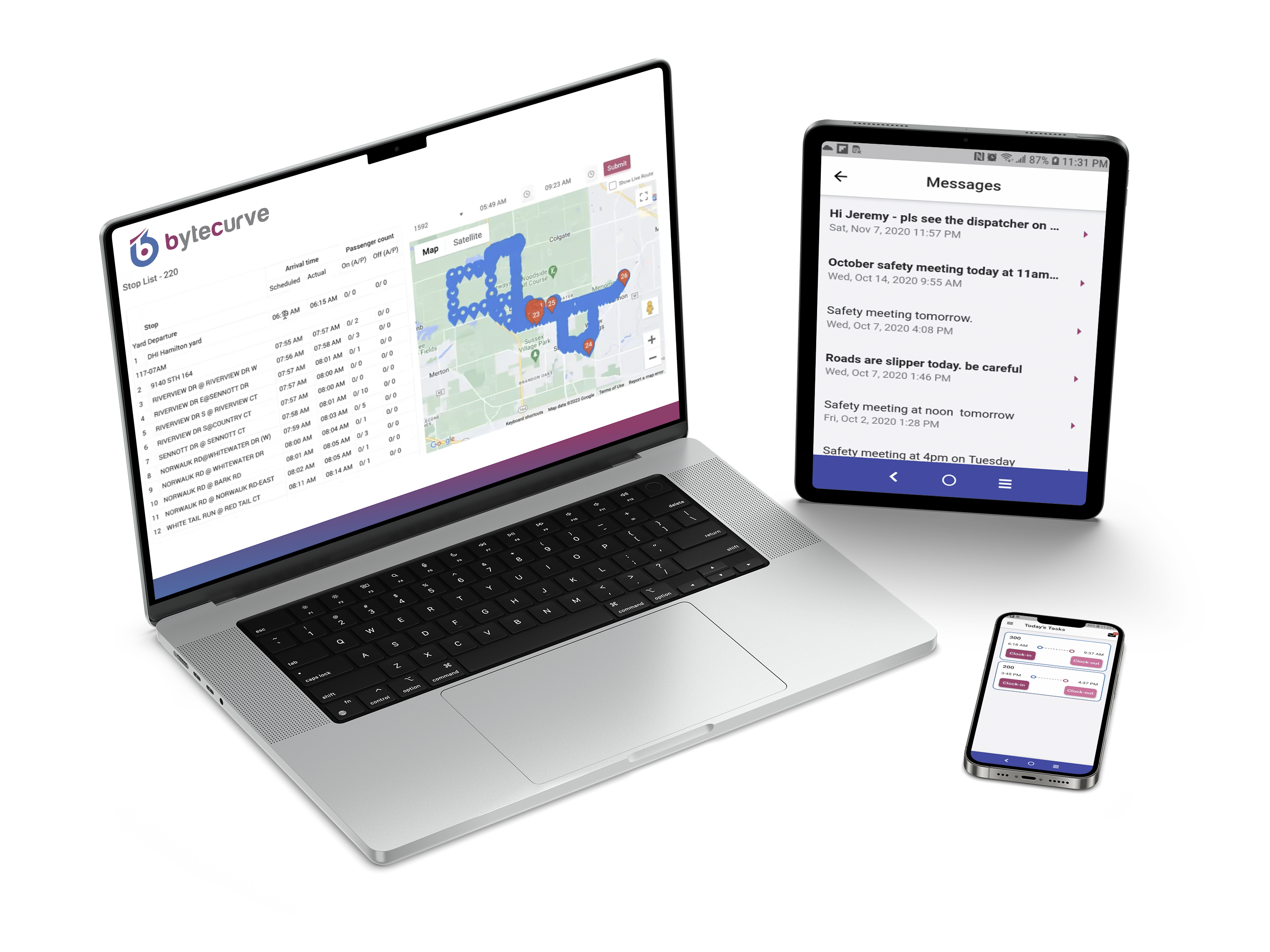

Today busHive is partnered with Bytecurve and other Transit Technologies solutions to deliver a full suite of transportation services.
From the powerful dispatching and payroll solution that slashes the burden of payroll management to vehicle safety cameras and maintenance and asset management, busHive and Transit Technologies are poised to deliver solutions that drive down costs and increase efficiency across transportation departments.

Bytecurve 360
The FMIS Built for School Transportation
Bytecurve 360 is the only platform that combines real-time routing data, GPS fleet tracking, and maintenance management into a unified command-and-control dashboard for student transportation operations. Unlike generic fleet software adapted from commercial logistics, Bytecurve is built specifically for the workflows, compliance requirements, and operational realities of school transportation.
Core FMIS capabilities include:
Scheduling and dispatch management
Assign drivers, manage route changes, and track daily operations from a single dashboard
Real-time GPS integration
Merge routing data with live fleet tracking to monitor bus locations, route adherence, and on-time performance
Digital inspections and compliance
Pre-trip, post-trip, and safety inspection workflows that create audit-ready compliance records
Maintenance tracking and work order management
Automated PM scheduling, technician labor tracking, and parts consumption tied to specific vehicles
Payroll processing
Automated time verification from GPS and routing data, eliminating manual timesheets and buddy-punching
Analytics and reporting
Total cost of ownership dashboards, budget forecasting tools, and board-ready executive summaries
Bytecurve is trusted by dozens of districts across North America with 40,000+ school buses on the platform. The platform is part of the Transit Technologies family of companies and is built by former student transportation veterans who understand the operational pressures districts face.
“We needed a system that reflected the professionalism of our company.”
How Bytecurve Solves the Data Problem
Most school districts struggle with data silos — routing software that doesn’t talk to GPS systems, maintenance records trapped in spreadsheets, payroll processed manually from paper timesheets. Bytecurve eliminates those silos by consolidating all operational data into a single platform.
The result:
- Transportation directors see real-time fleet availability, route performance, and maintenance status in one dashboard
- Mechanics receive automated work orders with parts lists and labor estimates
- Drivers use the DriveOn mobile app to complete digital inspections, clock in/out, and receive route updates
- Business offices receive automated payroll data verified against GPS and routing records
- School boards receive board-ready reports showing cost-per-bus, lifecycle cost projections, and capital replacement forecasts
This level of integration is what transforms school transportation from reactive chaos to strategic control.

What Is a Fleet Management Information System?
A Fleet Management Information System (FMIS) is a centralized digital platform that consolidates all fleet operations data — vehicle maintenance records, work orders, parts inventory, fuel consumption, driver assignments, route performance, and asset lifecycle costs — into a single command-and-control dashboard. Unlike generic maintenance tracking spreadsheets or adapted enterprise software, a purpose-built FMIS is designed specifically for the workflows, compliance requirements, and reporting needs of fleet operations.
For school transportation, an FMIS serves three critical functions:
1. Operational visibility
Real-time insight into vehicle availability, maintenance status, shop productivity, and route performance
2. Financial defensibility
Total cost of ownership tracking, lifecycle cost analysis, and budget forecasting tools that turn capital requests into data-backed recommendations
3. Compliance documentation
Automated inspection records, PM completion tracking, and audit-ready reporting that satisfy state DOT requirements and federal safety regulations
The difference between a district running spreadsheets and one running an FMIS is the difference between hoping you have enough buses tomorrow and knowing exactly which assets need attention, when they need it, and what it will cost.

“The calls, complaints, and headaches that were typical with the previous system have been essentially eliminated.”

Russellville saves $15,000 per month in payroll
“We had a lot of spreadsheets and a lot of time invested in keeping all of our routes and drivers organized before we went on this journey to improve how we do business,”
– Christopher King, Transportation Director, Russellville School District

Rome Public Schools reduced payroll by $30,000 per month with Bytecurve
“The time we were spending on tracking all of these timecards and fixing all of the mistakes was significant and required rigorous reviews in our department and the payroll department,”
— Elander Graham, Rome Transportation Director
Why School Districts Need More Than Spreadsheets
Most school transportation departments start with the same tools: Excel trackers, paper work orders, handwritten inspection logs, and a maintenance schedule kept in someone’s head. It works — until it doesn’t. The hidden cost of that approach reveals itself in three critical areas:
1. Budget Conversations Without Data
When transportation directors request funding for vehicle replacement or shop equipment, they are often forced to rely on anecdotes: “Bus 47 has been in the shop three times this month” or “We really need to replace the 2012 models.” Without verifiable cost-per-mile data, lifecycle cost tracking, or utilization metrics, those requests are vulnerable to cuts.
According to Fleet Maintenance Magazine, vehicle downtime costs public agencies an average of $448 to $760 per vehicle per day. Emergency roadside repairs add another $350–$700 per incident. But if you cannot show the board exactly which buses are driving those costs and what replacement would save, you are asking them to take your word for it.
An FMIS makes those costs visible and attributable — by vehicle, by route, by fiscal year.
2. Reactive Maintenance Driving Up Costs
The Federal Motor Carrier Safety Administration has documented that carriers with ongoing maintenance violations have 65% higher future crash rates — proof that deferred maintenance is never just a financial risk. It is a safety risk.
Yet without automated preventive maintenance scheduling, most districts default to reactive repairs. A bus comes in with a problem, the shop fixes it, and the cycle repeats. The Commercial Vehicle Safety Alliance’s 2024 International Roadcheck results found that 23% of inspected commercial vehicles were placed out of service for maintenance violations — including brake defects, tire issues, and lighting problems that structured PM programs prevent.
An FMIS automates PM scheduling based on mileage, engine hours, or calendar triggers — ensuring every bus gets serviced on schedule rather than when something fails.
3. No Visibility Into Asset Lifecycle or Replacement Timing
Most districts replace buses when they break down beyond repair — not when data indicates they have reached the end of their cost-effective service life. That approach leaves money on the table in two ways:
- Keeping buses too long — Maintenance costs per mile escalate sharply in the final years of a bus’s life. Without lifecycle cost tracking, districts often spend $8,000–$12,000 annually keeping an aging bus on the road when replacement would be more cost-effective.
- Replacing buses too early — On the flip side, some districts replace buses on arbitrary age thresholds (e.g., “all buses older than 12 years”) without considering actual condition, mileage, or total cost of ownership. That approach wastes capital dollars on premature replacement.
An FMIS provides vehicle lifecycle management tools that score every bus on age, mileage, maintenance spend, and condition — automatically surfacing which units need replacement before they become a crisis.
“When it was all on paper, where we were flipping through trying to figure out who’s next in line, it was easy to skip someone. busHive makes it so much easier.”
The Five Core Capabilities of a Fleet Management Information System
A purpose-built FMIS for school transportation delivers five interconnected capabilities that transform how districts operate, budget, and plan for the future.
1. Preventive Maintenance Scheduling & Work Order Management
An FMIS auto-generates preventive maintenance schedules based on mileage, engine hours, or calendar triggers — and tracks PM completion, overdue services, and technician labor in a single dashboard. For school districts, this means buses are serviced on schedule rather than when something fails.
Key features include:
- Automated PM work order generation with configurable service intervals
- Technician labor tracking and shop productivity metrics
- Digital work order assignment and completion workflows
- Parts consumption tracking tied to specific work orders
- Mobile access for mechanics to update job status in real-time
The U.S. Department of Energy estimates that proper preventive maintenance can improve fleet fuel efficiency by roughly 10% on average — and that every 1 psi drop in tire pressure reduces fuel economy by 0.2–0.3%. When PM schedules are automated and tracked digitally, those savings become visible and recoverable.
2. Vehicle Lifecycle Management & Asset Replacement Scoring
The most defensible vehicle replacement decisions are driven by data, not crisis. An FMIS implements a vehicle replacement scoring system that accounts for age, mileage, total maintenance spend, and condition index — automatically ranking buses by replacement priority with supporting cost data ready to present to leadership.
Key features include:
- Multi-factor asset scoring (age, mileage, maintenance cost, condition)
- Automated replacement priority rankings updated in real-time
- Historical cost-per-mile tracking by vehicle and model year
- Lifecycle cost projections for budget planning
- Capital replacement forecasting by fiscal year
This approach shifts replacement planning from crisis-driven guesswork to data-backed lifecycle planning aligned with industry benchmarks. It also gives transportation directors the ammunition they need to defend capital requests to school boards.
3. Total Cost of Ownership (TCO) Reporting & Budget Forecasting
An FMIS gives transportation directors instant access to total cost of ownership by vehicle, route, or department — including cost-per-mile, downtime attribution, and utilization rates. According to the American Transportation Research Institute, fleet maintenance costs average $0.202 per mile and represent roughly 8.9% of total operating expenses. Being able to show this data by bus type, route, or service year gives school boards the financial lens they need to approve capital requests.
Key features include:
- Cost-per-mile tracking by vehicle, model, and year
- Total cost of ownership dashboards with drill-down capability
- Budget vs. actual variance reporting
- Multi-year capital replacement forecasting
- Customizable board-ready reports and executive summaries
When you can show the board exactly what the fleet has cost and what it will cost to maintain current service levels, budget conversations change from requests to recommendations.
4. Digital Inspections & Compliance Tracking
Under 49 CFR Part 396, all regulated fleet vehicles must undergo systematic inspection, repair, and maintenance with documented recordkeeping. For school buses, state DOT requirements often exceed federal minimums — requiring pre-trip inspections, post-trip inspections, and annual safety certifications.
An FMIS provides digital pre-trip, post-trip, and safety inspection workflows — replacing paper-based processes with a searchable, auditable compliance record.
Key features include:
- Customizable digital inspection checklists
- Driver-facing mobile inspection workflows
- Automated defect reporting and work order creation
- Compliance reporting for state DOT audits
- Historical inspection records searchable by vehicle, driver, or date
Digital inspections turn regulatory compliance from a paperwork burden into a daily operational asset — and create the audit trail needed to defend the district in the event of an incident.
5. Fuel Management & Telematics Integration
Modern FMIS platforms integrate with GPS tracking systems, fuel card programs, and vehicle telematics to consolidate fuel consumption, vehicle diagnostics, and driver behavior data in one platform. This integration eliminates data silos and gives transportation directors a complete operational picture.
Key features include:
- Fuel card integration with transaction-level tracking
- GPS-based mileage verification and route performance analysis
- Telematics-driven maintenance alerts (fault codes, battery health, tire pressure)
- Fuel efficiency tracking by vehicle, route, and driver
- Idle time monitoring and driver behavior scoring
When telematics and maintenance data feed into a single FMIS, fuel savings become visible and recoverable. The U.S. Department of Energy’s Alternative Fuels Data Center confirms that proper maintenance and monitoring can improve fleet fuel efficiency by roughly 10% on average — a figure that translates directly to budget savings when tracked systematically.

“The quoting feature lets us calculate a trip cost quickly, so the school knows the cost of the trip prior to doing it.”
The Business Case: How an FMIS Transforms School Transportation Operations
The return on investment for a Fleet Management Information System is measurable across three dimensions: cost savings, operational efficiency, and budget defensibility.
Cost Savings: Reduced Downtime, Lower Maintenance Spend
Research from Fleet Advantage confirms that fleets with strong PM compliance experience approximately 20% fewer downtime days than those managing reactively. For a district running 100 buses at an average downtime cost of $600 per bus per day, that translates to tens of thousands of dollars in avoided costs annually.
Additionally, structured PM programs extend vehicle life and reduce total lifecycle costs. The U.S. Department of Energy estimates that organizations with strong PM programs save 12–18% compared to reactive operations — a savings that compounds year over year.


Operational Efficiency: Time Savings and Shop Productivity
Manual data entry, spreadsheet management, and paper-based work orders consume hours of administrative time every week. An FMIS automates those workflows — freeing up transportation staff to focus on operations instead of paperwork.
Typical time savings include:
- 10–15 hours per week in automated reporting (replacing manual spreadsheet compilation)
- 5–8 hours per week in work order processing (replacing paper-based systems)
- 3–5 hours per week in parts inventory tracking (replacing manual bin counts)
For a transportation department with limited administrative staff, those hours translate directly to capacity for strategic planning, driver training, and proactive maintenance.
Budget Defensibility: Data-Backed Capital Requests
The most important ROI is often the hardest to quantify: the ability to secure funding from school boards. When transportation directors can present board-ready reports showing cost-per-mile by vehicle, lifecycle cost projections, and data-backed replacement priorities, capital requests shift from “we need new buses” to “here is exactly what we need, when we need it, and what it will cost.”
Districts with strong FMIS data consistently secure higher replacement funding because they can demonstrate the cost of inaction. That credibility compounds year over year — turning the transportation department into a trusted financial partner rather than a cost center asking for money.


“We can get a request today and be ready to dispatch a bus tomorrow and not have it disrupt us. busHive makes it easy to route it across all the approvals and get the driver assigned in no time.”
Frequently Asked Questions:
Fleet Management Information Systems for School Districts
What is a Fleet Management Information System and why do school districts need it?
A Fleet Management Information System (FMIS) is a centralized digital platform that consolidates all fleet operations data — vehicle maintenance records, work orders, parts inventory, fuel consumption, driver assignments, route performance, and asset lifecycle costs — into a single command-and-control dashboard. School districts need an FMIS because it replaces reactive “fix it when it breaks” approaches with structured preventive maintenance programs that reduce unplanned downtime, extend asset life, and generate the audit-ready records needed to defend budget requests. According to the U.S. Department of Energy, organizations with strong PM programs save 12–18% compared to reactive operations.
How does an FMIS differ from maintenance tracking spreadsheets?
Spreadsheets are static records that require manual data entry, offer no automated workflows, and provide no real-time visibility into fleet status. An FMIS automates preventive maintenance scheduling, generates work orders based on mileage or time triggers, tracks parts consumption in real-time, integrates with GPS and telematics systems, and produces board-ready reports with a few clicks. The difference is the difference between hoping you have enough buses tomorrow and knowing exactly which assets need attention, when they need it, and what it will cost.
How do we justify an FMIS investment to the school board?
The most effective approach is showing the cost of not having the system. Vehicle downtime costs $448–$760 per vehicle per day. Emergency repairs average $350–$700 per incident. Deferred vehicle replacement dramatically inflates per-mile maintenance costs. An FMIS makes those costs visible and attributable — by vehicle, by route, by fiscal year. When you can show the board exactly what the fleet has cost and what it will cost to maintain current service levels, budget conversations change from requests to recommendations.
What compliance requirements apply to school bus maintenance programs?
Under 49 CFR Part 396, all regulated commercial fleet vehicles must undergo systematic inspection, repair, and maintenance with detailed recordkeeping and annual inspections. State DOT requirements for school buses often exceed federal minimums — requiring pre-trip inspections, post-trip inspections, and annual safety certifications. The CVSA’s 2024 International Roadcheck found that 23% of inspected commercial vehicles were placed out of service for maintenance violations. An FMIS provides digital inspection workflows, automated checklists, and searchable audit records that turn compliance from a paperwork burden into a daily operational asset.
How do you determine when to replace a school bus versus continue repairing it?
The most defensible approach is a data-driven vehicle replacement scoring system that accounts for age, mileage, total maintenance spend, and condition index. An FMIS implements exactly this methodology — automatically ranking buses by replacement priority with supporting cost data ready to present to leadership. This shifts replacement planning from crisis-driven guesswork to data-backed lifecycle planning aligned with industry benchmarks.
Can an FMIS support electric school bus transition planning?
Yes. Electric school bus fleet management introduces new maintenance requirements — less powertrain PM, but more attention to tires, thermal systems, software recall management, and charger uptime. A purpose-built FMIS supports mixed diesel/electric fleets with normalized cost-per-mile tracking, flexible PM trigger configurations for electric drivetrains, and the lifecycle cost visibility needed to plan EV transitions strategically.
How quickly can we expect results after implementing an FMIS?
Most districts see measurable improvements within the first 90 days, particularly in PM compliance rates, reporting time savings, and reduction in administrative hours. Mobile work order management and digital inspection tools eliminate manual data entry from day one — accelerating the accuracy of shop data. Longer-term outcomes — reduced unplanned downtime, improved budget defensibility, and data-backed replacement planning — typically become visible over the first 6–12 months as the historical data baseline grows.
Ready to Make the Shift from Reactive to Strategic?
The difference between a transportation department that struggles for funding and one that secures it consistently is data. An FMIS transforms school transportation from a cost center that asks for money into a data-driven operation that makes defensible requests backed by verifiable metrics.
Bytecurve 360 is the only platform that combines real-time routing data, GPS fleet tracking, and maintenance management into a unified command-and-control dashboard — giving transportation directors the operational visibility, financial defensibility, and compliance documentation they need to run a modern student transportation operation.
Join dozens of districts that have:
- Reduced payroll processing time by up to 80%
- Eliminated manual timesheets and buddy-punching with GPS-verified time tracking
- Achieved 95%+ driver adoption of mobile inspection and communication tools
- Saved tens of thousands of dollars annually through data-driven route optimization and lifecycle planning

Secure
Only authorized employees will be able to access DriveOn based on a customer specific access code. This code can be turned off as needed by an authorized administrator.

User friendly
DriveOn is easy to use with a simple, smart interface.
Available on both iOS and Google Play stores.